Saturday, March 25, 2017

TOW #24 - Visual Text "Urbanization Is Killing Us"

     Just in the 1900's, the only 14 percent of the world's population lived in urban areas. In 2008, the entire world was met with unprecedented urbanization with nearly an even split amongst people living in urban and rural areas.  While there have been many economic and social benefits with the population growth in cities, environmental effects have been an undeniable drawback.  In the street art image, the artist emphasizes the fact that urbanization has detrimental consequences to human race through the integration of personification and irony.
    The facade of this particular building is like none other, containing a meaning and a soul on the surface.  While the exterior of most buildings contain plaster, bricks, or concrete, the painting on this building personifies the undeniable issues with urbanization.  By drawing a human like figure eating trees, this metaphorically reveals that humans are destroying trees in the process of building urban areas. By giving life to the building, the artist gave a powerful meaning and purpose for the building, as civilians can see the personified building directly speaking to them.
   In the message that the mural attempts to convey to humans, the artist incorporates irony into the mix to strengthen the idea of the human obligation in preventing rapid urban growth. While the artist could have painted the same picture on a canvas, he rather placed it on an urban building itself in order drive home the point. This ironic placement of the painting makes the civilians living in the urban areas think about the effects of urbanization and its harmful impact to their environment.  By strategically placing an anti-urbanization drawing on a city building, the ironic situation makes more people recognize the need for less urban growth.
   While urbanization does have both beneficial factors and detrimental consequences, the artist effectively conveys the idea of the inimical effects that urban development can have on humans. By adding human like life to the building and strategically placing the drawing in an ironic location, the artist opens up the eyes of humans on the environmental consequences of urbanization.
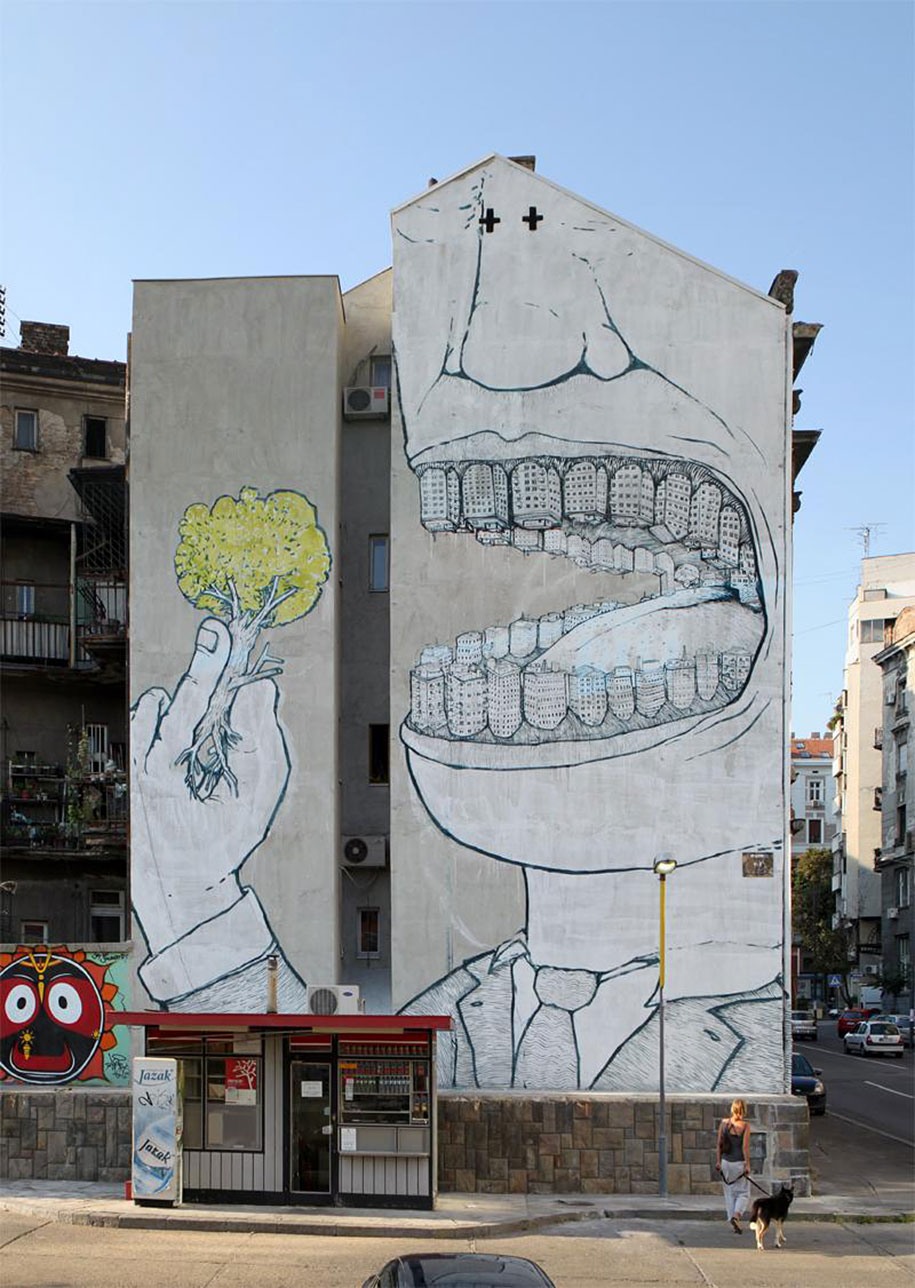
Image result for urbanization is killing us artist

Monday, March 20, 2017

TOW #23 - Global Ranking Of Happiness Has Happy News For Norway And Nicaragua Listen· 2:58

        The Global Hunger Index. The Gross Domestic Product. The Gross National Product. All these statistics are essential in evaluating the current state of a nation as well as their development as whole. While these data can be easily calculated when the data is collected, is it possible to measure the level of happiness in a country?  The United Nations recently revealed the rankings of the happiest countries around the world, an unique form of statistical data calculated for each individual nation. While the idea of ranking counties based on a mood may seem questionable, when analyzing the rankings, interesting patterns and meanings can be uncovered in the process.
      Currently, Norway and many other Scandinavian countries have topped the charts in terms of their overall emotional satisfaction, and the geographic locations of these countries are only one of many similarities. When closely examining these developed countries, not only do they share great wealth, but are also share "all the main factors found to support happiness: caring, freedom, generosity, honesty, health, income, and good governance". While the idea of ranking a country based on the citizens' feelings may seem arbitrary,  the patterns that emerge from the rankings reveal that the countries are not randomly ranked, but rather carefully placed in the order of the combinations of many vital factors for a healthy and happy country.  It is not merely a coincidence that the wealth European countries with high levels of income, health, and stable government are the homes to the happiest people in the world. In fact, researchers interview over 1000 people per country annually and ask numerous questions ranging from simple emotional health questions to complicated questions that identifies the "people's perceived level of freedom, generosity and trust - both in each other and in their government and businesses". While this data may not require number crunching such as GDP and GNP, the feedback that are collected are utilized to identify a sociological pattern within the 190 plus countries in the world. Clearly, continuous research that goes towards identifying a country's level of joy is much more sophisticated than many may think.
      Hence, while the global ranking of happiness may seem as a basic, unprofessional ranking system, when examining the factors that are included in putting the countries in order, one can see that the data is not merely made up, but rather a coagulation of intricate studies done by researchers.

Link: http://www.npr.org/sections/goatsandsoda/2017/03/20/520859626/global-ranking-of-happiness-has-happy-news-for-norway-and-nicaragua

Sunday, March 12, 2017

TOW #22 - South Korea’s democracy does the right thing — but that won’t solve all its problems

     March 9th, what may seem like any normal day, became a historic date for South Korea as its president, Park Geun Hye, was removed from office after months of unsettling protests across the nation. South Korea's young democracy hit a major obstacle with the corrupt leadership of Park and on Thursday, there seemed to be a light at the end of the tunnel for many South Koreans. However, the Editorial Board at the Washington Post believes that the impeachment of Park resolved only a portion of a much larger problem: complicated international relations.
     While there are evident issues still present throughout the nation, the Editorial Board accredits the South Korean young democracy for managing to handle the difficult political process of impeachment. While the process may have been a "testament" for the country, "for all the disruption and difficulty, the nation has managed to perform one of the most tricky maneuvers in a democratic system: undertaking the transfer of power under the rule of law at time of extreme duress". While the impeachment did not solve all the problems that the country had faced since the beginning of Park's tenure in office, it was a necessary first step towards recovering from political corruption. Before revealing the daunting problems that are yet to be dealt with for the currently unstable South Korean government, the Washington Post acknowledges the vital step that the nation undertook and commends their actions despite their inexperience with democracy.
     While the impeachment was necessary, the move did not solve most of the problems that were still left behind in part to Park's corrupt presidency. Currently, one of the greatest issue that the Korean government faces is their fragile relation with their neighbor, North Korea, as "Ms. Park took an unflinching stand toward Kim Jong Un's dangerous and unpredictable regime in North Korea". Despite Dictator Un proving his nation was a force to be reckoned with, Park's questionable decisions during her presidency jeopardized the relationship between the bordering countries. The costly moves that Park made in just the past year has left South Korea in hot water with enormous consequences to be dealt with.
      Although South Korea's historic movement has caught the attention of the world and is being celebrated across the nation, it is clear that the country still has numerous obstacles that are yet to be dealt with, most notably the relation with their neighbors up north.

Link; https://www.washingtonpost.com/opinions/south-koreas-democracy-does-the-right-thing--but-that-wont-solve-all-its-problems/2017/03/11/8aadde4a-05c4-11e7-b1e9-a05d3c21f7cf_story.html?utm_term=.389a37491d96

Friday, March 3, 2017

TOW #21 - IRB The Closer

     From being an ordinary kid on the streets of one of the most impoverished parts of Panama to being under the lights for the largest baseball franchises, Mariano Rivera has lived two polar opposite lives in his lifetime. While most immigrants such as Rivera may dream of living a stable life in a new land, the 13-time All Star paved an extraordinary life that most people in the entire world could not even imagine living. Through the sacrifices and drive to survive in America, Mariano Rivera reveals a life "of a legend built from the ground up" that everyone can appreciate and admire.
      Although Rivera eventually received notable accolades and will be remembered as Major League Baseball's all-time saves and ERA leader, thirteen-time All-Star, and a five-time World Champion, he did not by any means easily accomplish these goals. In fact, he had to work harder than most professional baseball players given the circumstances that Rivera was coming from. Coming from another country, the language barrier was the evident problem, but one of the toughest challenges for Rivera was the competition against experienced players as he describes his memory as, “All around me are guys who have been groomed to do this for a decade or more, and here I am, a guy who got here because one Sunday afternoon the Panama Oeste Cowboys needed somebody to finish a game.” No one would have imagined Rivera, a mere fisherman who occasionally played baseball with fishing nets and wooden sticks, to compete against talented Americans who had been playing their entire careers.  His tenacity to continue his survival in the new land was extraordinary as he left behind his family, friends, and even his future wife, Clara, with complete faith in his religious beliefs and his strong work ethic that he acquired back from working in the labor intensive fishing boats. While the chances of making it into the Majors is ever so slim, Rivera managed to accomplish the goal with even more obstacles the majority of professional baseball players, ultimately making his journey a story that everyone must respect.
      From the sandlot by the dirty beach to the world-famous Yankees Stadium, Mariano Rivera made history through his incredible motive.  Even with all the odds in the world against him, Rivera established himself as one of the most dominant athlete of all time, all while possessing composed character that everyone can learn from. Therefore, it comes to no surprise that Rivera is now know as "The Closer".